Work
Eight years, in full. Some of these have a case study behind them; the rest carry their detail here — what the thing is, what I actually built, and what it runs on.
35 entries
Mobile apps
- 2025 — 2026shipped
ARYA
AI investing assistant
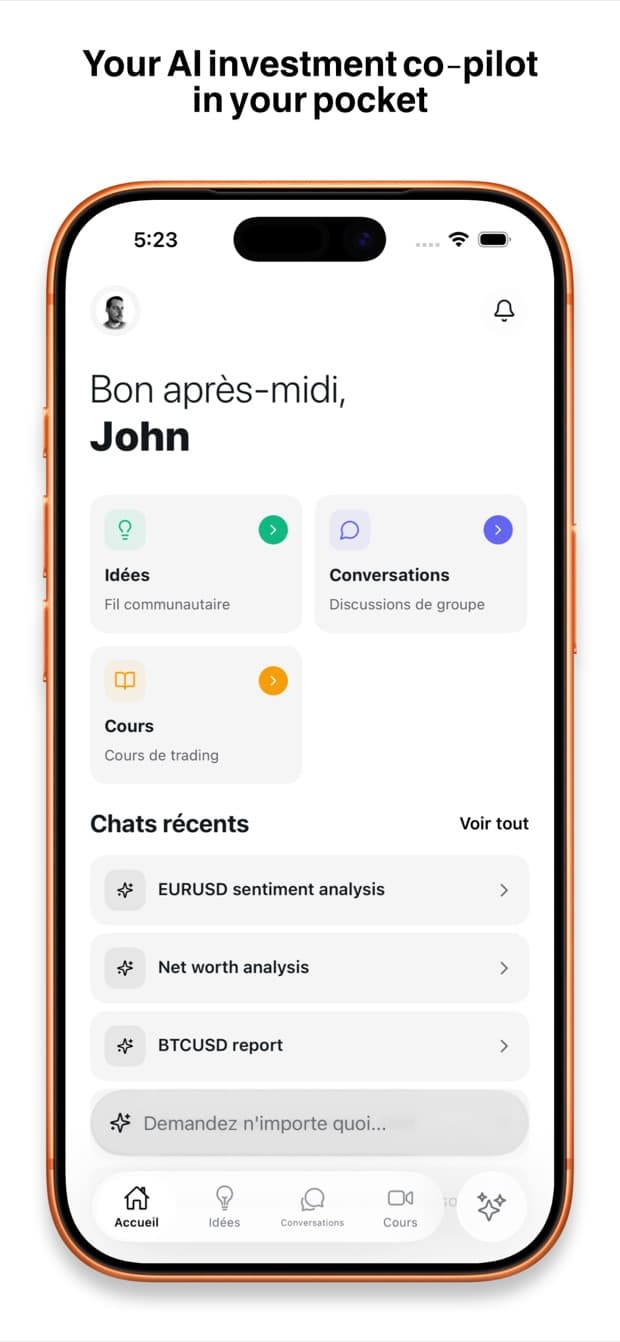
An investing app built around an assistant: ask about any market in voice or text and get analysis back, rather than reading a chart and guessing.
- Smart price alerts arrive with the reason attached — the AI explains what moved and why — instead of a bare threshold notification.
- Scheduled research runs on the assets a user follows and delivers reports on their own terms, turning a manual habit into something the app does overnight.
- A community feed and a course library sit alongside the markets, so the app covers learning as well as watching. English and French throughout.
- Sole engineer, front end and back end, on iOS, Android and Mac, including subscription billing through both stores.
- React Native
- Expo
- TypeScript
- Node.js
- Apple IAP
- Google Play Billing
- 2025 — 2026shipped
ARYA Wealth
Personal wealth and net-worth platform
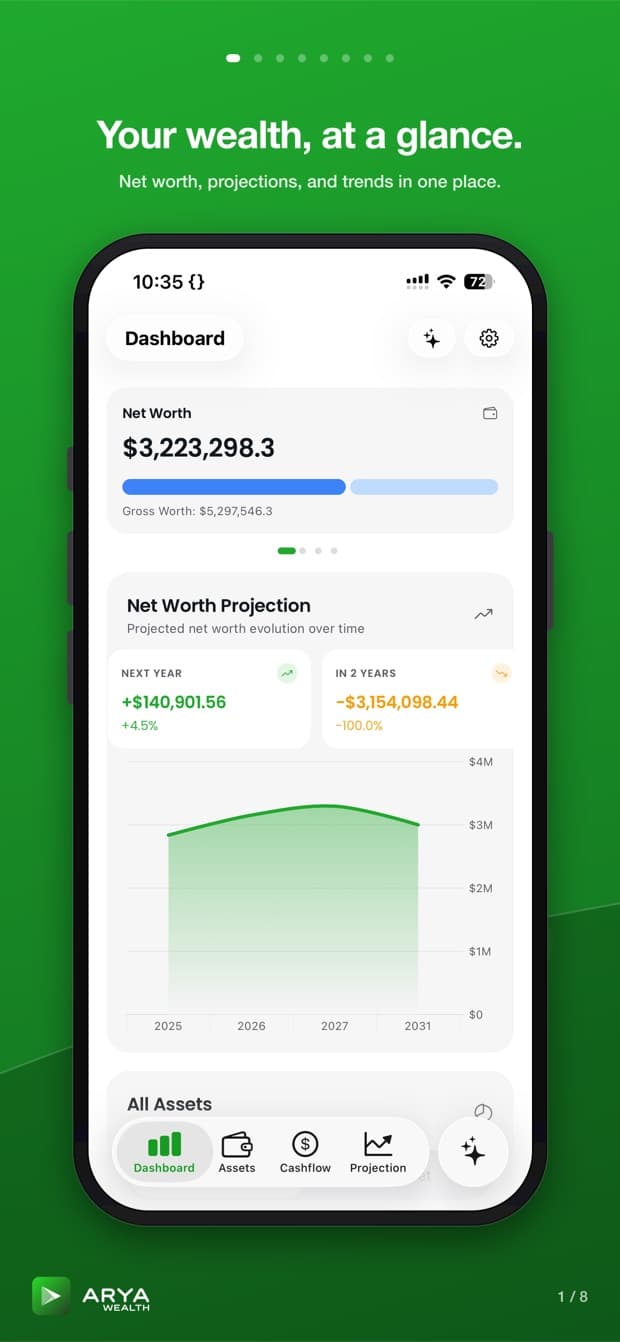
A whole balance sheet in one place: cash and equities, real estate with the mortgages attached to it, private equity, and asset classes the owner invents.
- Projections run year by year over a decade — income, expenses, planned purchases — and can be stress-tested, which is the difference between a tracker and a planning tool.
- Multi-currency by design: assets are held in any supported currency and converted to the owner's home currency, so the spreadsheet maths disappears.
- An AI assistant answers questions against the real portfolio — exposure to a sector, whether a purchase is affordable next year — with charts and tables inside the app.
- Ships on iPhone, iPad, Mac and Apple Vision Pro from one codebase. Free for the tracking; the assistant is the paid tier.
- React Native
- Expo
- TypeScript
- Node.js
- visionOS
- Multi-currency
- 2026shipped
Greenbull Club
Private investor community
A members-only app for Greenbull investors: a community feed, a searchable member directory, and the events the membership is actually for.
- Masterclasses and property viewings are browsed and reserved in the app, and a QR membership card gets the member through the door on the day.
- The member directory is searchable and filterable by city and country — the feature that turns a feed into a network.
- Shipped from first release to a filterable directory and a media library in about six weeks.
- React Native
- Expo
- TypeScript
- Node.js
- QR
- 2026 — presentlive
Iqra
Multilingual Qur'an companion
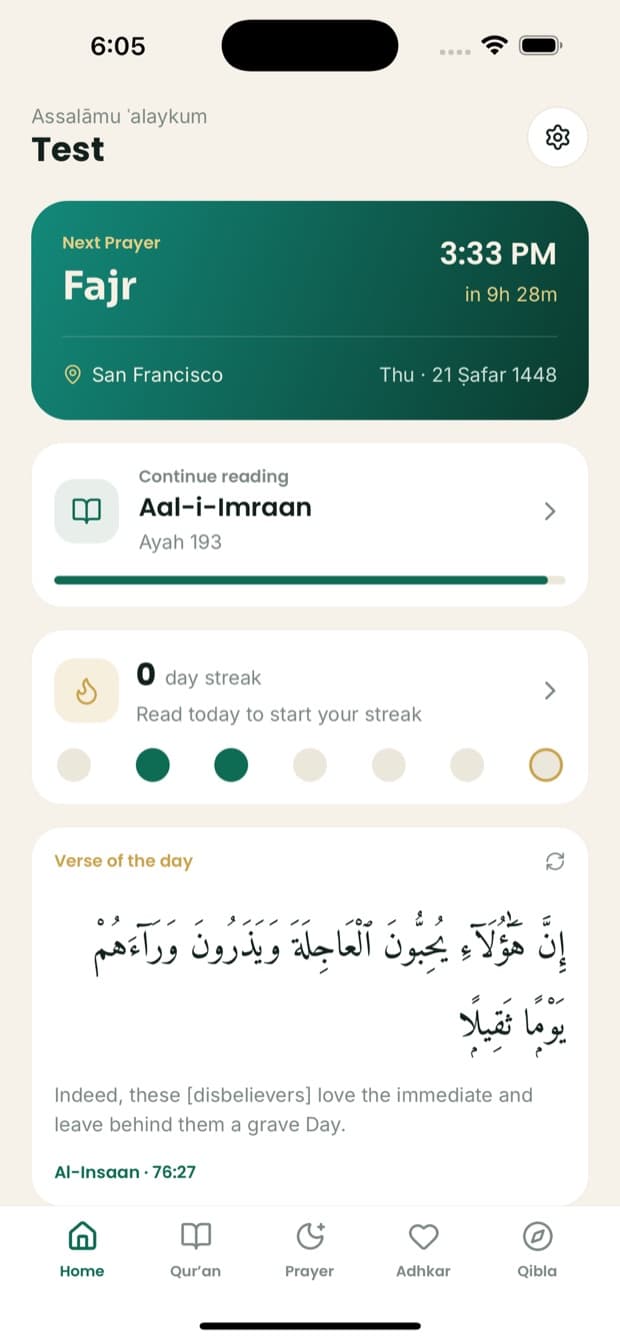
A daily companion for the Qur'an, prayer and remembrance — fully bilingual in English and Arabic, with no accounts, no ads and no tracking.
- All 114 surahs in full Uthmani text, with verse-by-verse audio from nine reciters, continuous or verse-by-verse playback, and live highlighting that follows the recitation.
- Mushaf page mode reads exactly like a printed copy — Juz labels, pinch to zoom, and long-press any ayah to play, bookmark, share or open its tafsir.
- Translations in English, Urdu, French and Indonesian plus transliteration, with Tafsir al-Muyassar alongside the verses, and any surah downloadable for offline listening.
- Published under ENTLAQA LLC on both stores, with a web companion at iqra.outworx.io.
- React Native
- Expo
- React Native Web
- TypeScript
- Arabic / RTL
- Offline audio
Web & platforms
- 2026 — presentin development
Steadhold
Backend-as-a-Service platform
A project request returns an isolated PostgreSQL 17 database in about 2.5 seconds, with auto-generated APIs, authentication, row-level security and object storage.
- Control plane and data nodes, with an eleven-step provisioning saga where every step asks whether the thing already exists before it creates it — which is what lets a worker be killed mid-run and resume without duplicating a container, a volume, a credential or a capacity booking.
- Operations to the same standard: WAL archiving, point-in-time restore into a fresh project, and a verifier that restores each backup and checks recovery, page checksums, pg_amcheck and row counts — then is deliberately fed a corrupted backup to prove it can still fail.
- Organisations with three enforced roles, an append-only audit log held by a database trigger, per-project ES256 keypairs published over JWKS, and envelope-encrypted secrets.
- TypeScript
- PostgreSQL 17
- Docker
- PgBouncer
- PostgREST
- pgBackRest
- Next.js
- Prometheus
- Grafana
- Loki
- Cloudflare R2
- 2026 — presentlive
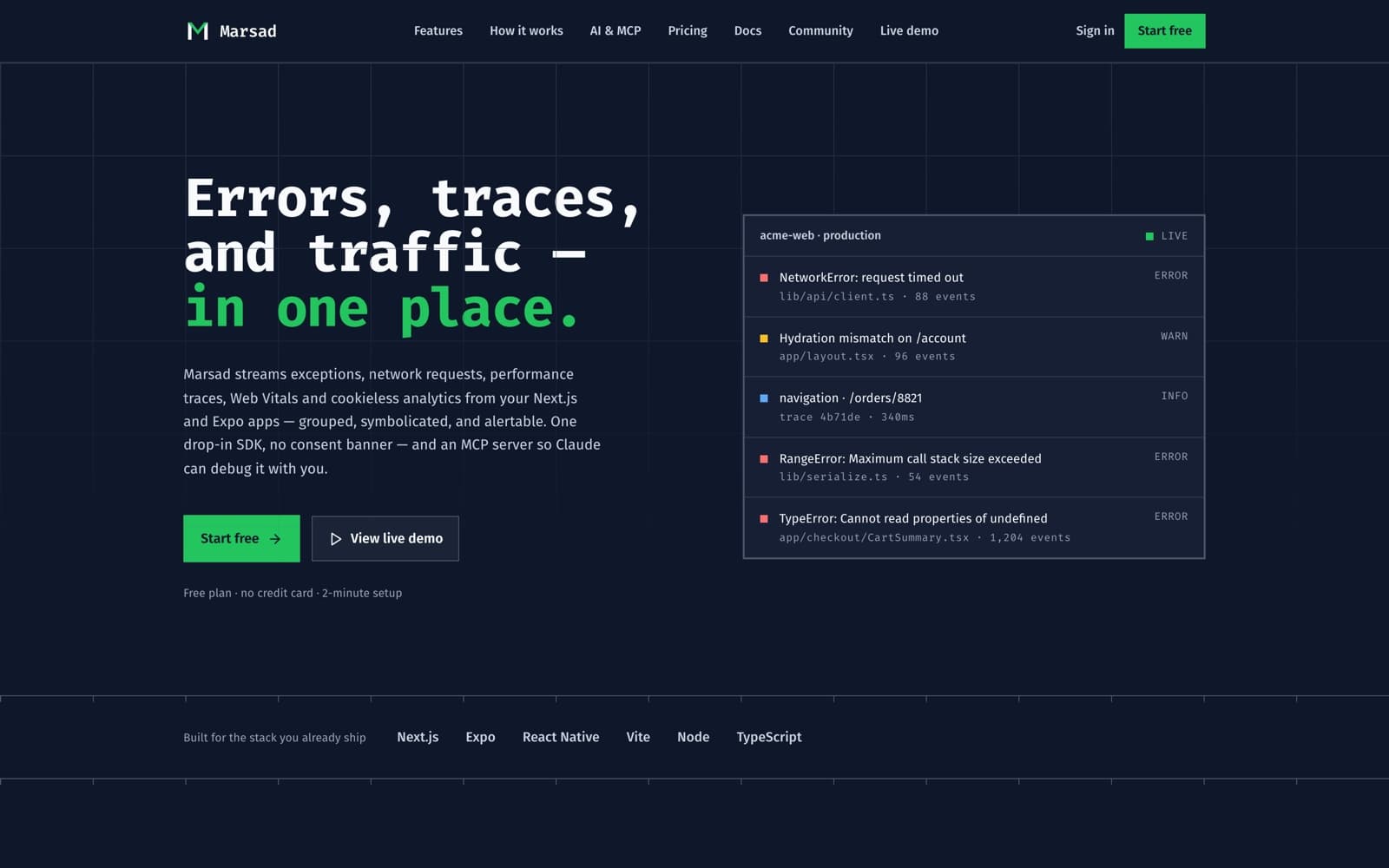
Marsad
Error, performance and analytics platform
One SDK carrying errors, traces, Web Vitals and cookie-free analytics out of Next.js and Expo apps — including crashes that happen before JavaScript is running.
- Debug IDs match each build to its source map automatically, so minified web frames and Hermes frames resolve to real files and lines with no release bookkeeping.
- Native crash capture across iOS signals, NSException, Swift traps, Android JVM crashes, ANRs and C++ aborts, queued offline and sent on the next launch.
- A remote MCP server with fourteen tools behind an OAuth 2.1 consent screen, so an assistant can find, explain, assign and comment on production issues.
- TypeScript
- Next.js
- Expo
- React Native
- PostgreSQL
- Swift
- Kotlin
- C++
- OAuth 2.1
- MCP
- Resend
- Stripe
- 2026 — presentlive
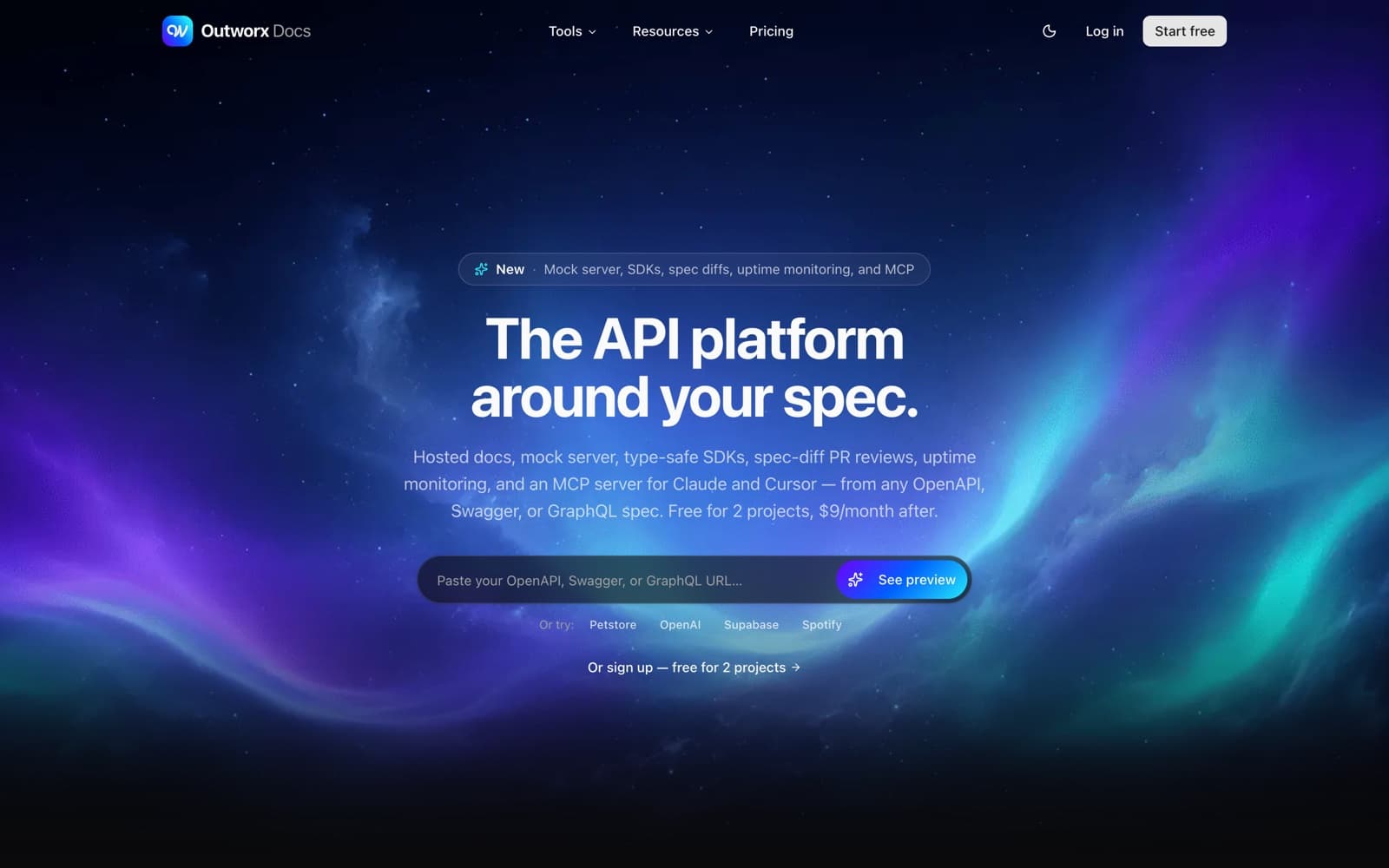
Outworx Docs
API documentation and developer platform
Upload one API spec and the whole toolchain comes out of it in under a minute: hosted docs, a mock server, typed SDKs, spec diffing, uptime monitoring and an MCP server.
- The mock server is generated straight from the spec — schema-walked sample data, named examples cycled through the standard Prefer header, stateful overrides pinned from the dashboard, and real GraphQL execution — so a front-end team can build against an API before its backend exists.
- SDK generation produces a single drop-in TypeScript or Python file with typed methods and a client class, with no codegen toolchain on the consumer's side. For GraphQL specs it emits one typed function per query, mutation and subscription with default selection sets.
- Spec diffing detects breaking changes and the required semver bump, and drops the diff into every pull request through a composite GitHub Action and the @outworx/cli package. Uptime probes run every ten minutes per endpoint with public status pages.
- Every project ships its own MCP server with twelve tools — list and search endpoints, generate typed clients, run live calls with the developer's own credentials, and answer questions grounded in the spec — plus an AI chat drawer on the docs site that cites the endpoint it answered from.
- Multi-tenant underneath: organisations, role-based access, an audit log that can stream to a SIEM, custom domains with automatic SSL, versioning, and tiered billing that is not charged per seat.
- Next.js
- TypeScript
- PostgreSQL
- OpenAPI 3
- Swagger 2
- GraphQL
- MCP
- GitHub Actions
- Resend
- Stripe
- 2026 — presentlive
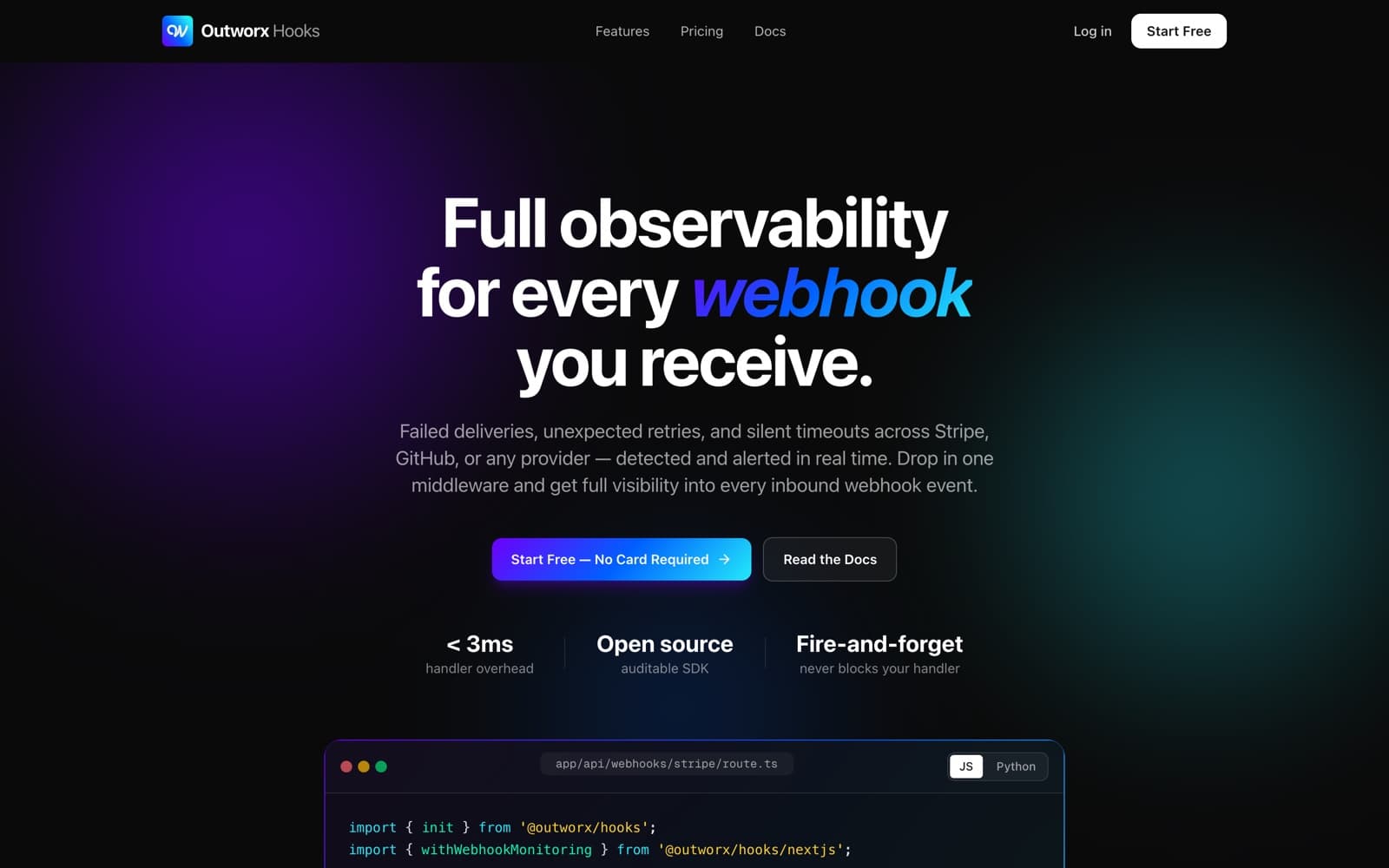
Outworx Hooks
Webhook monitoring and observability
Monitoring for inbound webhooks from Stripe, Shopify, GitHub, Clerk, Supabase or anything else that speaks HTTP, installed by wrapping one handler.
- The SDK runs inside the handler rather than in front of it, which is the only position from which you can catch the worst failure mode: a handler that returns 200 and never processes the event because of an early return, a swallowed exception or a missing await. A reverse proxy physically cannot see that.
- Signature failures are diagnosed rather than reported — timestamp drift, wrong secret, or a body that was re-serialised before verification — with the concrete fix named.
- Telemetry is fire-and-forget and adds under three milliseconds, so if the monitoring is down the webhook still runs exactly as before. Open-source agents ship for Next.js, Express, Fastify and FastAPI.
- P50, P95 and P99 latency out of the box, anomaly alerting on volume drops and latency spikes, AI summaries of failures, per-provider alert rules to Slack, Discord and email, and ninety days of searchable payloads that can be replayed against staging.
- TypeScript
- Python
- Next.js
- PostgreSQL
- Resend
- Stripe
- npm
- PyPI
- 2026 — presentlive
Intilq
AI social media campaign platform
One prompt becomes a complete multi-channel campaign: copy, images, hashtags and a posting schedule, written natively in Arabic dialects and English rather than translated.
- A voice profile is learned from the account's own past posts, so generated campaigns sound like the brand instead of like a model. A product library keeps real products in the creative rather than stock imagery.
- Publishing goes through native platform APIs to Instagram, TikTok, LinkedIn, Facebook and X, with per-platform formats and captions generated for each rather than one post copied five times.
- Arabic is composed natively per dialect — Gulf, Egyptian, Levantine, Maghrebi — which is the part most tools get wrong, because a translated caption reads like a tourist with a phrasebook.
- Timezone-aware scheduling with an approval step before anything publishes, a unified inbox for comments, DMs and mentions, and analytics that show a dash where a platform's API cannot measure something rather than a fake zero.
- Next.js
- TypeScript
- PostgreSQL
- LLM APIs
- Image generation
- Platform APIs

- 2026 — presentlive
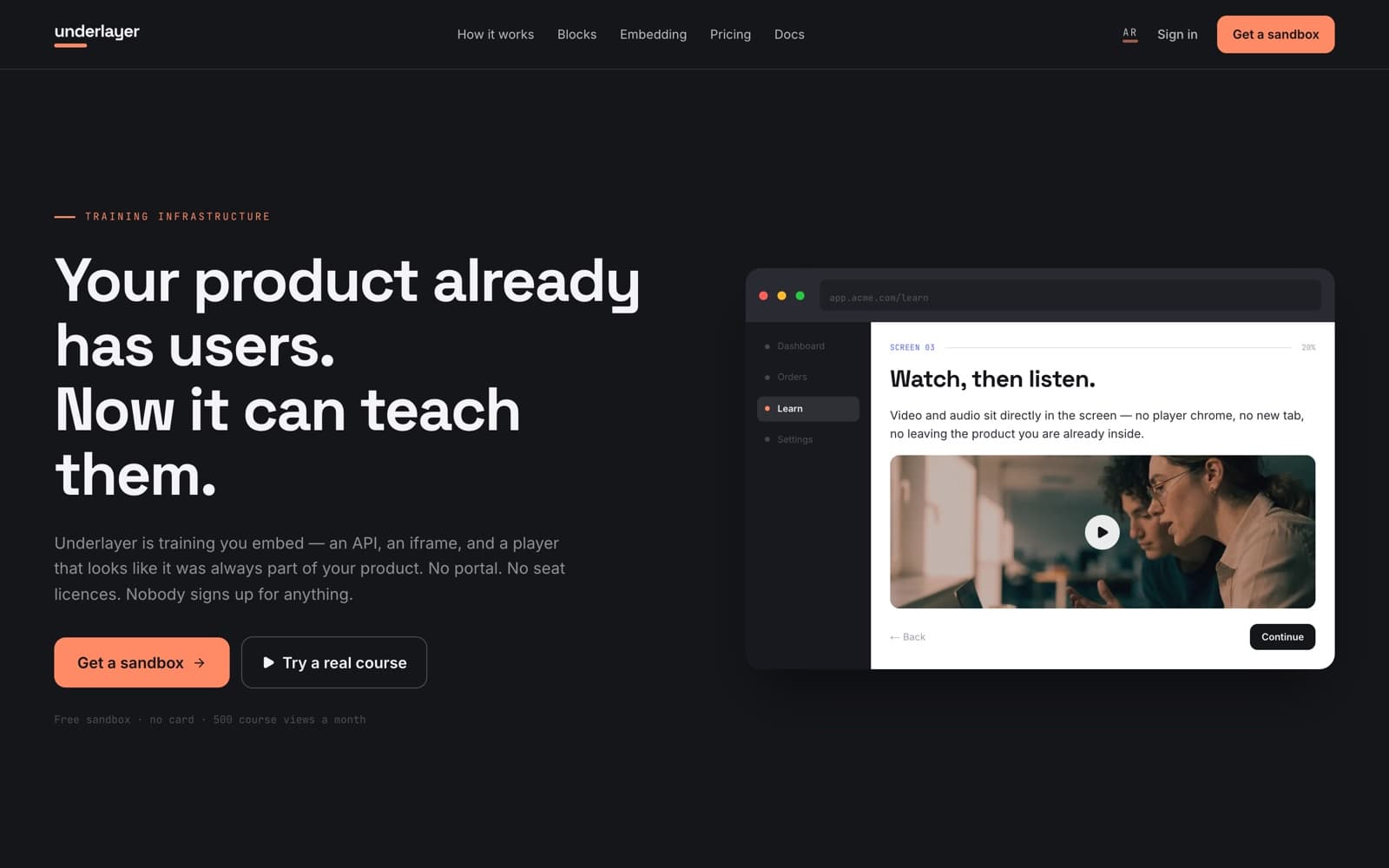
Underlayer
API-first embedded training platform
Training that a product embeds inside itself — an API, an iframe and a white-label player — instead of sending its users to somebody else's LMS.
- Learners never make an account. The host app passes the identity it already has on the iframe URL, and progress, answers and completions are tied to that id, so there is no sign-up, no invitation email and no second password.
- Thirty-nine content blocks, none of which look like a form: six question types, flashcards, drag-to-match, hotspot images, timelines, decks, scenarios, code, polls and reflections — all of which take the host product's theme.
- Right-to-left is done properly: Arabic and Hebrew mirror the whole layout, including the spine, arrows and drag direction, not just the text.
- Results leave through webhooks (course completed, certificate issued, screen viewed) and a REST API, with SCORM 1.2 and 2004 export for customers who are not leaving their existing LMS. Billing is per course view, not per seat.
- Next.js
- TypeScript
- PostgreSQL
- REST
- SCORM
- MCP
- 2026 — presentlive
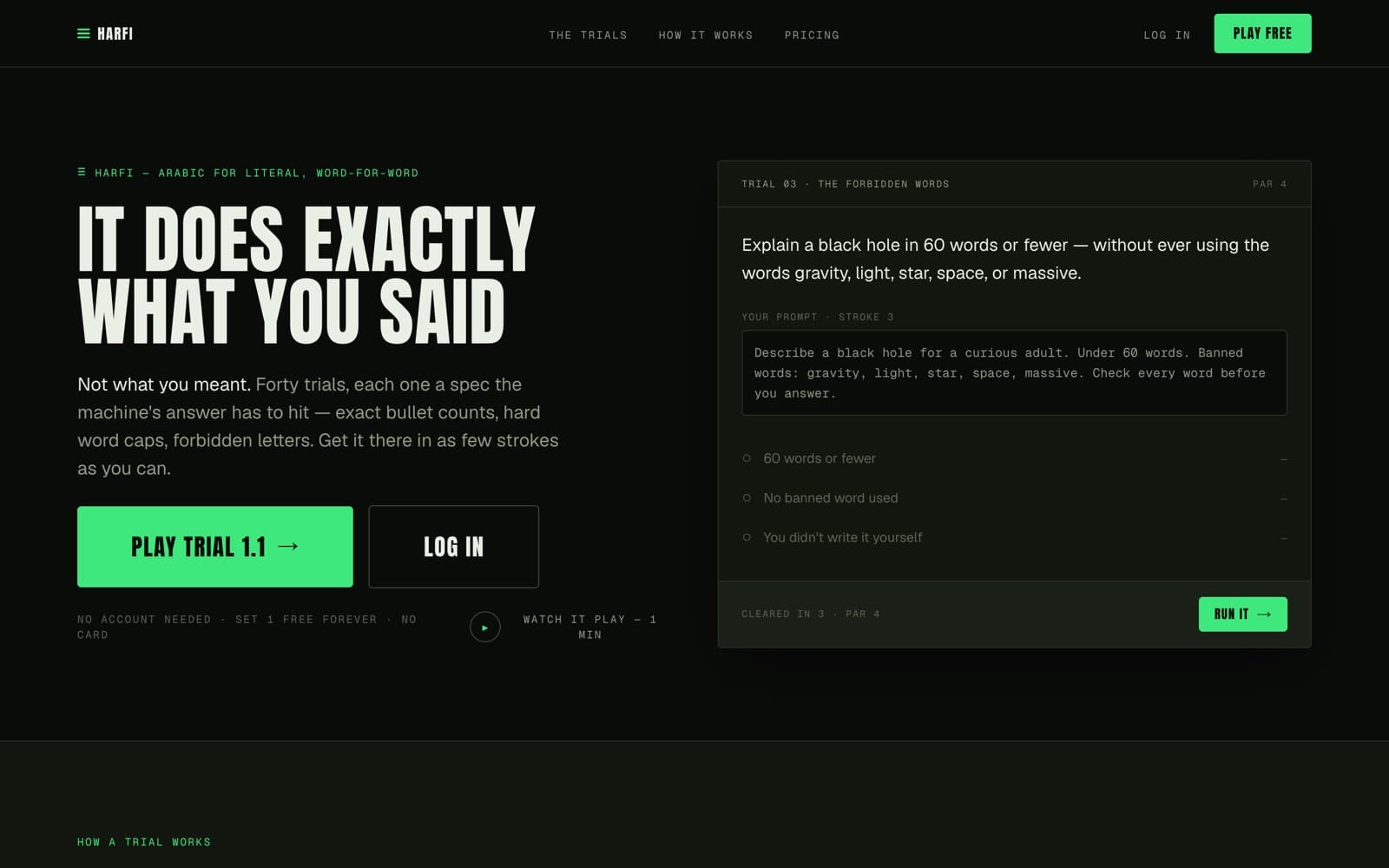
Harfi
Prompt-engineering game
Forty trials in making a model produce exactly what you specified — exact bullet counts, hard word caps, forbidden letters, valid JSON with no fence.
- Scored by a parser, in code: bullets are counted, words are counted, JSON is parsed, banned letters are searched for. No language model judges the answer, so the same attempt always scores the same and the player is told exactly which rule broke and by how much.
- Golf scoring across five sets — shape, schema, forbidden, transform, control — with four medals per trial, including one for clearing it in a prompt under twenty-five words.
- The opponent model is deliberately not the strongest available: a model that follows every instruction perfectly would make the trials trivial. The final set runs the same prompt against a second model to test whether it holds.
- Next.js
- TypeScript
- Claude Haiku 4.5
- Deterministic scoring
- 2026 — presentlive
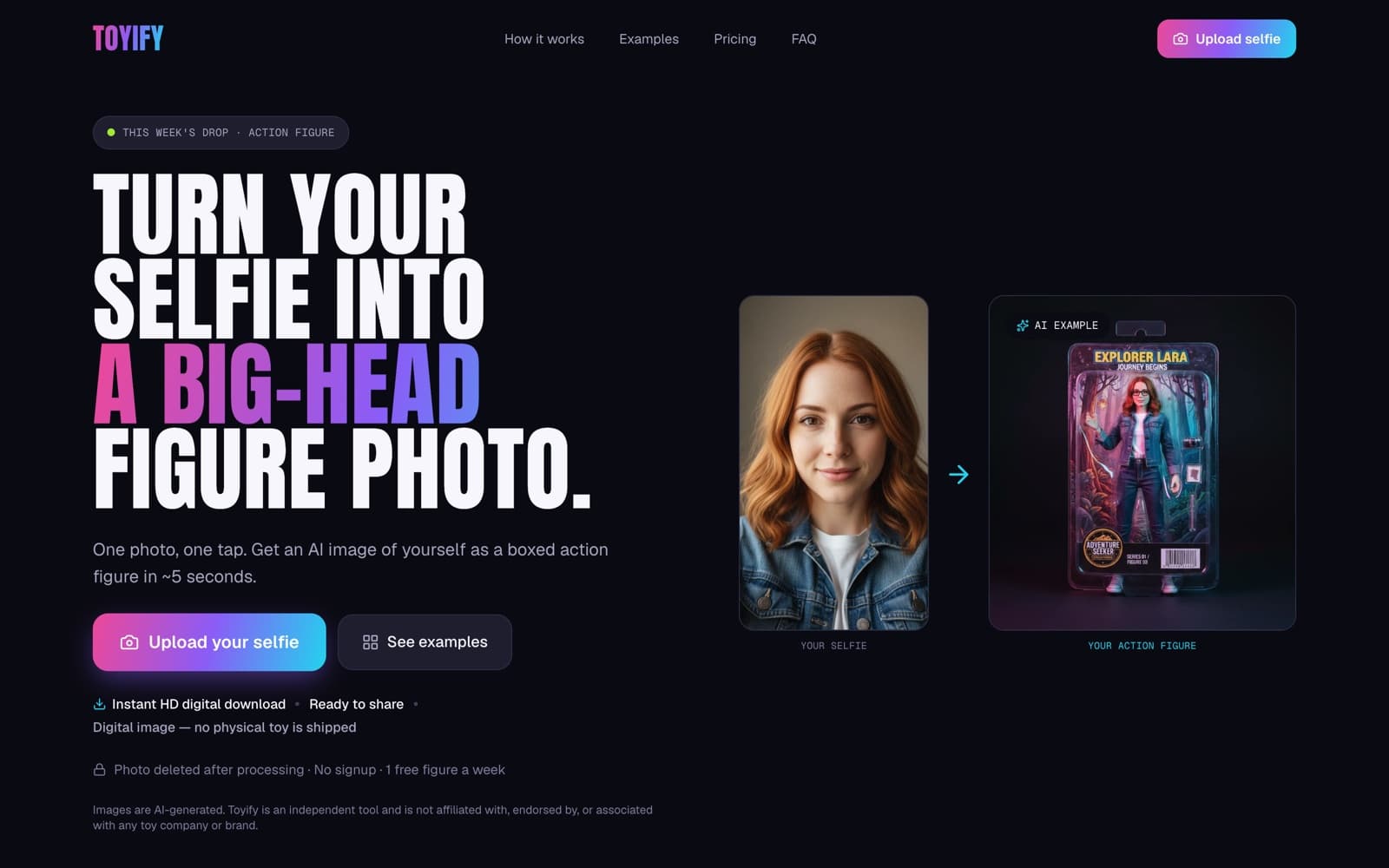
Toyify
AI image generation
A selfie becomes a boxed collectible action figure in about five seconds, in five styles.
- Image-to-image models on Replicate, with the pipeline tuned for a five-second round trip because anything slower loses the casual user who came from a link.
- Privacy is the product decision that shaped the build: no sign-up, no account, and the photo is deleted after processing — which also means there is no user table to breach.
- Revenue without a subscription: one free watermarked figure a week, then paid HD downloads and style packs.
- Next.js
- TypeScript
- Replicate
- Stripe
- 2025 — 2026shipped
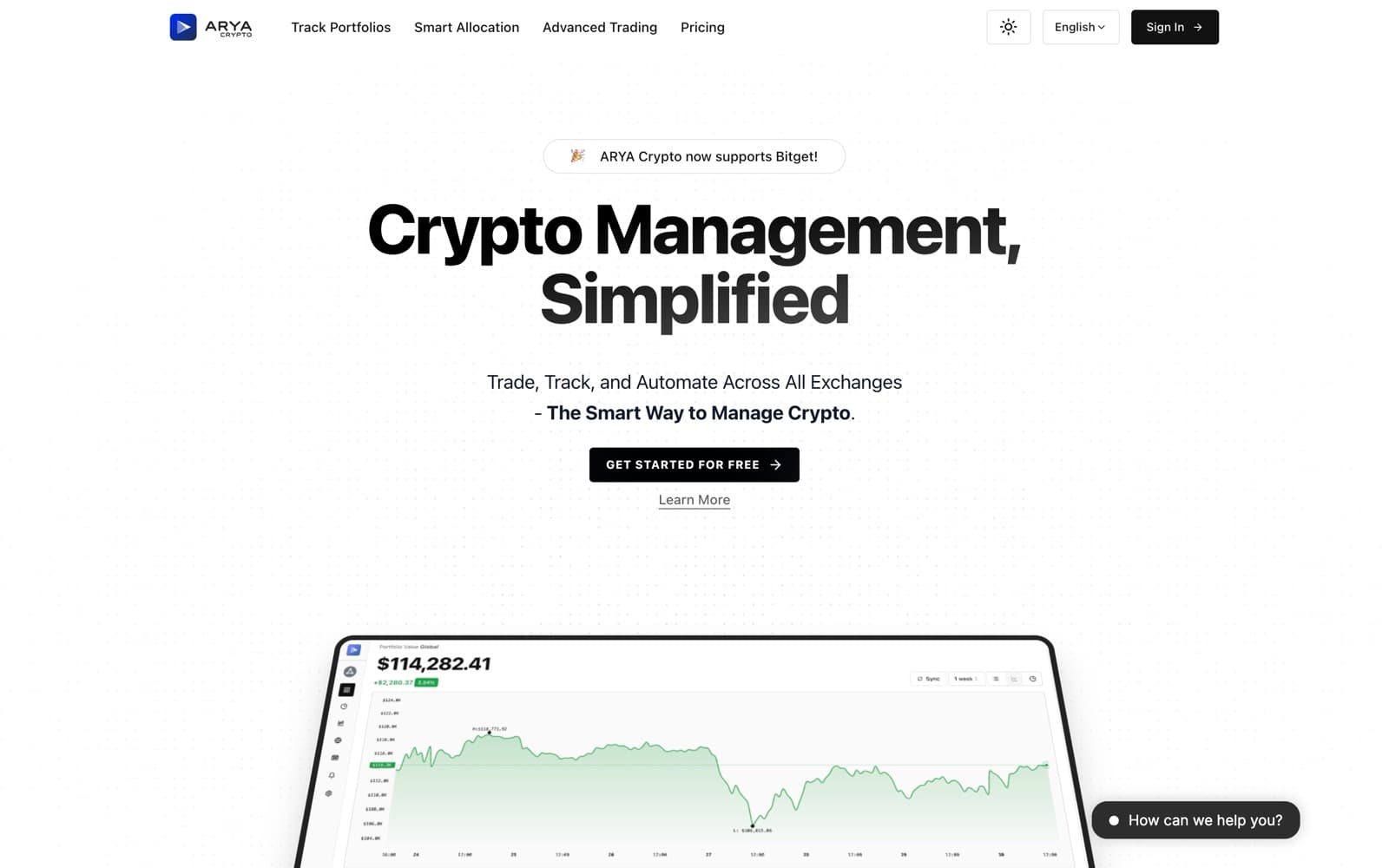
ARYA Crypto
Multi-exchange crypto platform
Portfolio management and automated trading across connected exchanges. I built the entire front end.
- One dashboard across every connected exchange, with sub-accounts and paper trading alongside live positions.
- Automation the user configures rather than code: target-weight allocation, dollar-cost-averaging rebalance rules, and profit-protection exits that sell a set percentage when the portfolio drops by one.
- Advanced order entry — stop loss, take profit, trailing and conditional orders — built to stay legible while showing live prices, which is most of the difficulty in a trading interface.
- Next.js
- TypeScript
- React
- Exchange APIs
- 2026 — presentin development
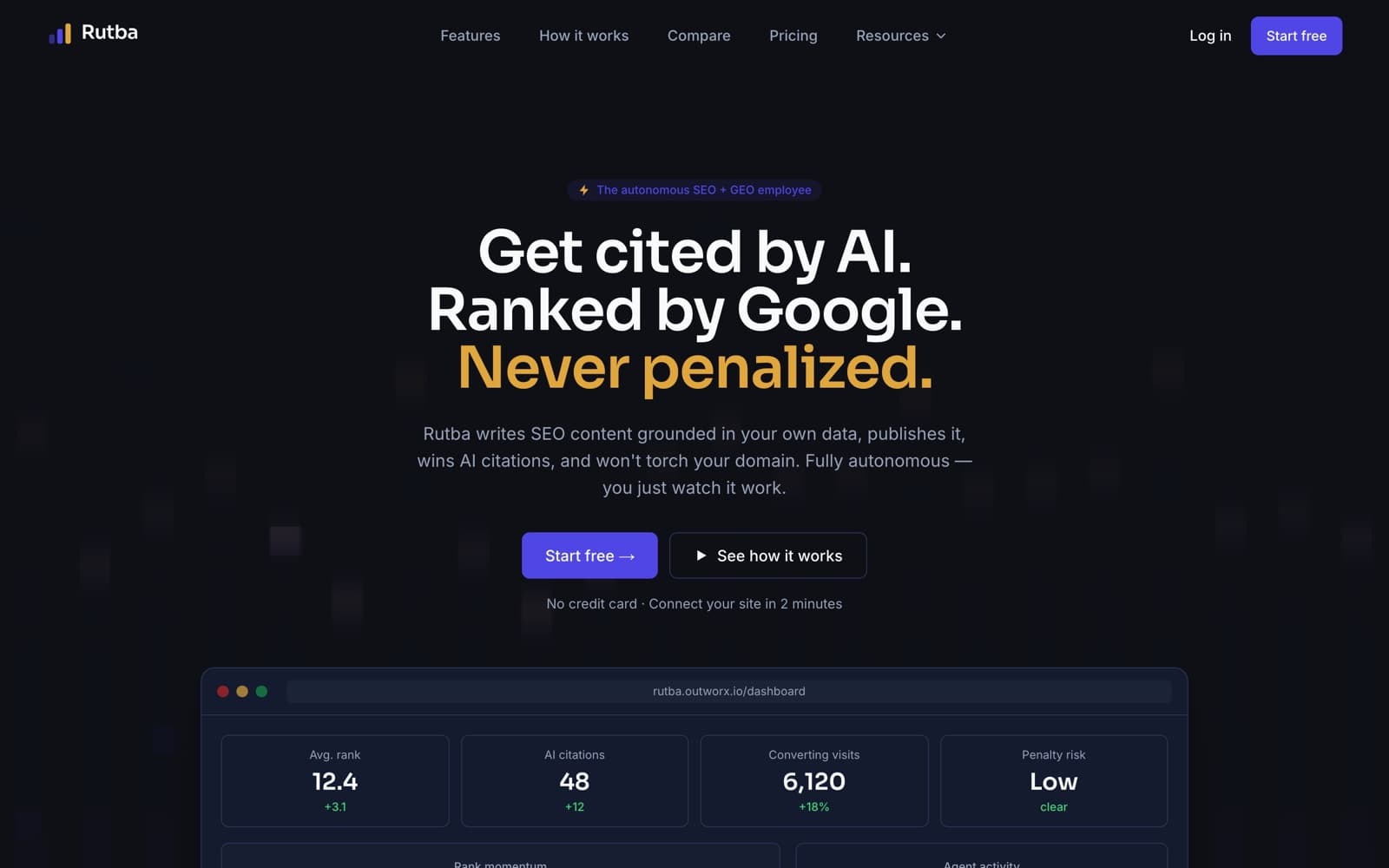
Rutba
Autonomous SEO and GEO agent
Writes SEO content grounded in a customer's own data, publishes it to their CMS, and tracks whether AI assistants cite it — not just where Google ranks it. In development.
- The problem it is built against is specific: mass-produced AI content with no original data got hit hard by scaled-content penalties, so an autopublisher that writes plausible filler is a liability rather than a tool.
- Three mechanisms carry that weight — insights mined from the customer's own Search Console, product and support data so every article contains a statistic that exists nowhere else; a fact-bind step that strips any number without a source; and a uniqueness gate that blocks commodity content before it publishes.
- Optimises for citation as well as rank, because the overlap between Google's top links and what an AI assistant quotes is small — so it tracks citation share inside assistants alongside keyword position.
- Publishes directly into 19+ content platforms, and runs either with an approval step or fully autonomously.
- Next.js
- TypeScript
- LLM APIs
- Inngest
- CMS integrations
- Resend
- Stripe
- 2026 — presentlive
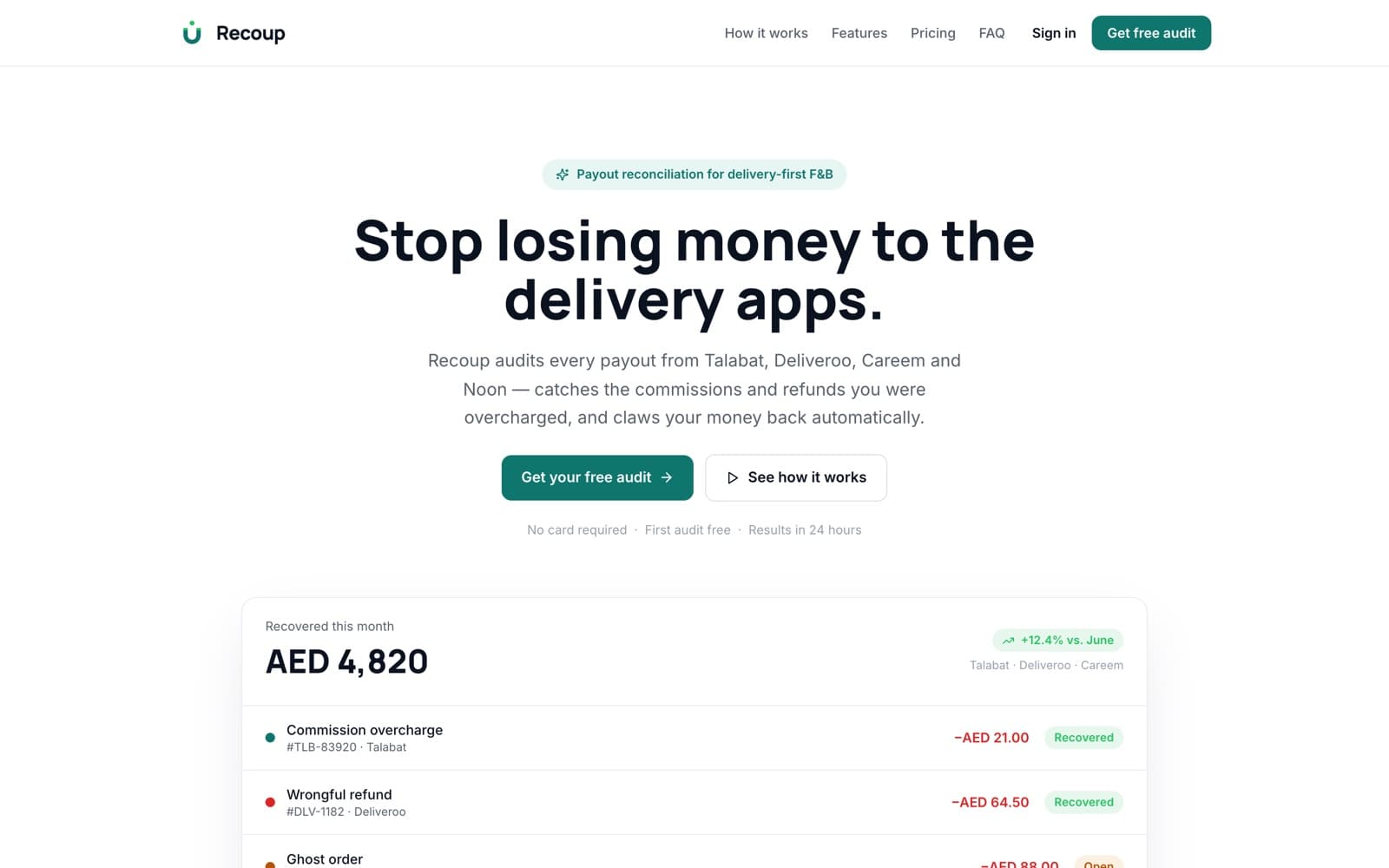
Recoup
Payout reconciliation for delivery-first F&B
Audits every payout from Talabat, Deliveroo, Careem and Noon, finds the commissions and refunds a restaurant was overcharged, and packages the evidence to claim it back.
- The hard part is reconciliation, not reporting: every order is matched to every payout line across platforms, and nine distinct leak types are detected — commission overcharges, wrongful refunds, ghost orders, cancelled-order fees, missing deposits and the rest.
- Each finding ships with the exact order and statement line attached, assembled into a dispute pack the platform cannot wave away, and tracked until the claw-back lands.
- Built to need no integration work from the restaurant: statements are uploaded or forwarded to a private inbox, rather than asking a kitchen to run an IT project.
- Priced as a flat monthly fee plus a share of money actually recovered, so the product only earns when it works.
- Next.js
- TypeScript
- Inngest
- LLM APIs
- Resend
- Stripe
- 2026 — presentlive
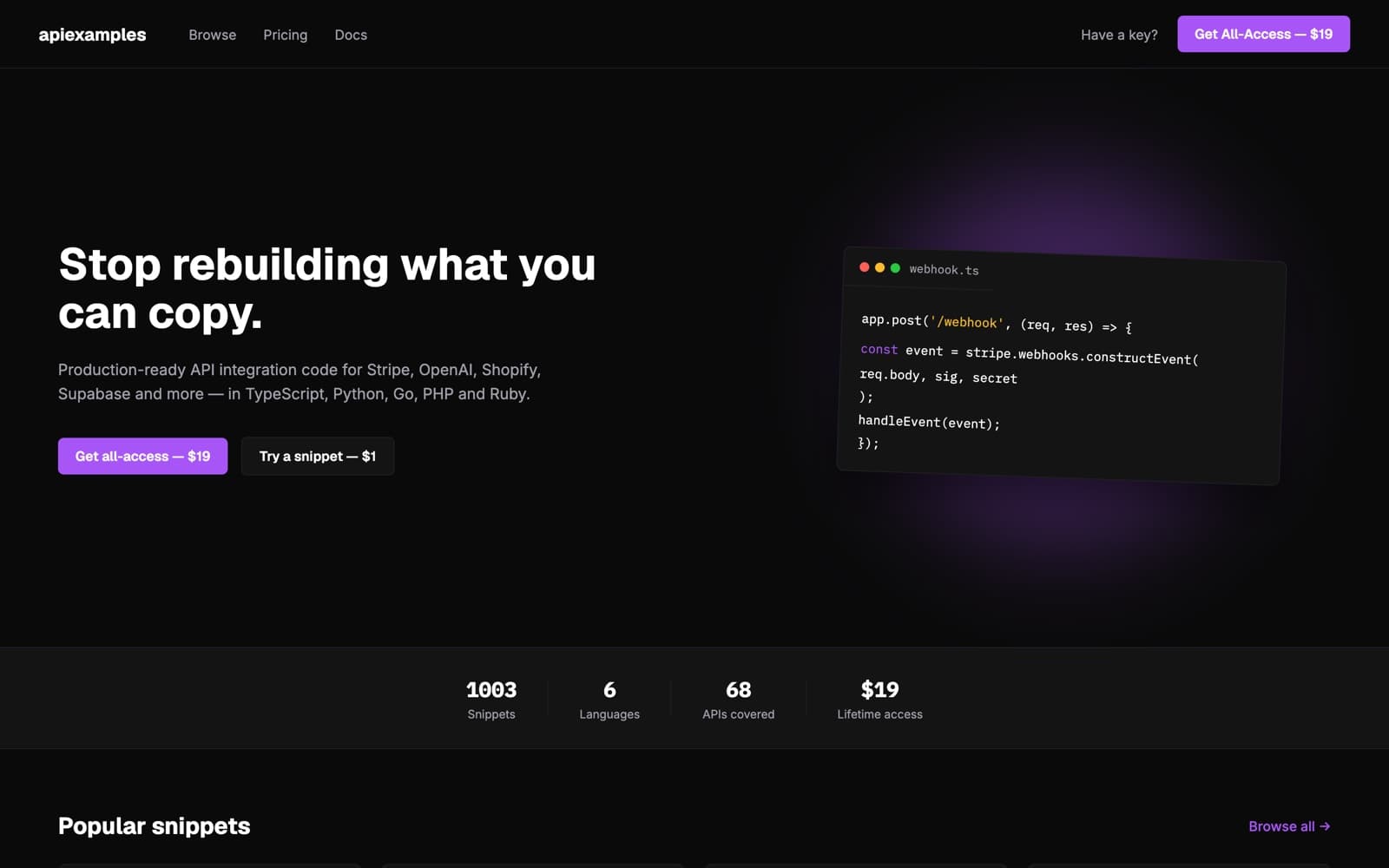
apiexamples
Production-ready API integration snippets
Over a thousand working integration snippets for 68 APIs — Stripe, OpenAI, Shopify, Supabase and more — in TypeScript, Python, Go, PHP and Ruby.
- Each snippet is the code you would otherwise rewrite from a docs page: webhook signature verification, streaming completions, auth middleware, protected routes — correct on the first paste.
- Sold once rather than rented: a single snippet, lifetime access to everything, or an MCP tier that puts the library inside an AI assistant.
- Next.js
- TypeScript
- MCP
- Resend
- Stripe
- 2026 — presentlive
Dearly
Reminders for the people you love
Remembers every birthday and anniversary, then sends a warm nudge days ahead with the gift ideas already attached.
- Deliberately small: add a name and a date, save gift ideas when they occur to you, and the product's entire job is to arrive at the right moment by email.
- Free for three people, then a low yearly subscription — a price that only works because the product does one thing and does not need a dashboard.
- Next.js
- TypeScript
- Appwrite
- Inngest
- Resend
- Stripe

Desktop apps
- 2026 — presentlive
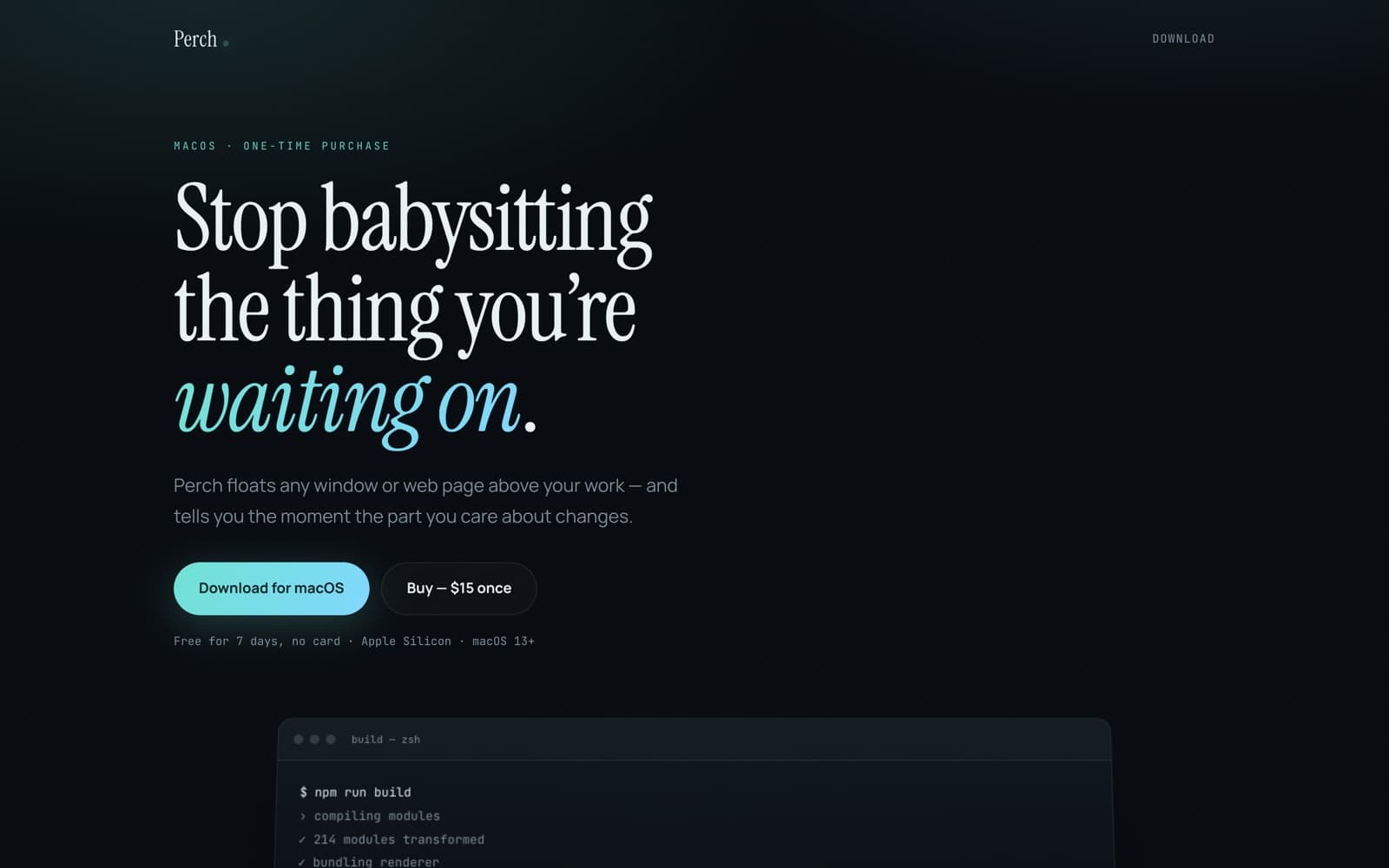
Perch
macOS utility
Floats any window or web page above your work and tells you the moment the part you care about changes — a build finishing, a render completing, a status flipping.
- Watches a region rather than an application, so it works on anything on screen: a terminal, a CI page, an export dialog, a queue that has no notification of its own.
- Sold once, for a small fee, with a free trial and no subscription — a utility priced like a utility.
- Electron
- React Native
- TypeScript
- macOS
- Apple Silicon
npm packages
- npmlive
@marsadco/sdk
One SDK, every runtime
Errors, network, performance traces, Web Vitals and cookieless analytics for Next.js and React Native — one package that behaves correctly in every runtime it lands in.
- The hard part of a client SDK is that the same code runs in a browser, in a server component, in a service worker and in Hermes, where the available APIs differ in each. One entry point, twelve releases of narrowing those differences.
- Ships with no runtime dependencies, because an observability SDK that drags a dependency tree into someone's app is a liability rather than a tool.
- TypeScript
- Next.js
- React Native
- Expo
- Zero dependencies
- npmin development
@marsadco/react-native
Native crash capture for React Native
Catches the crashes JavaScript never sees — iOS signals, NSException, Swift traps, JVM crashes, ANRs and C++ aborts — and sends them on the next launch.
- Native code on both platforms, because by the time the process is dying there is no JavaScript left to run: the report is written to disk and picked up when the app next starts.
- Pairs with @marsadco/sdk rather than duplicating it, so a team adds native crash capture without changing how anything else is reported. In beta.
- Swift
- Kotlin
- C++
- Expo Modules
- TypeScript
- npmlive
@outworx/hooks
Webhook monitoring SDK
Wraps an existing webhook handler in one line and reports what happened inside it, including the deliveries that return 200 and quietly do nothing.
- Runs inside the handler rather than in front of it, adds under three milliseconds, and is fire-and-forget: if the monitoring is down, the webhook still runs exactly as before.
- No runtime dependencies, so it can sit in the request path of someone's payment webhook without bringing anything with it.
- TypeScript
- Next.js
- Express
- Fastify
- Zero dependencies
- npmlive
@outworx/cli
Spec push from CI
Pushes an OpenAPI, Swagger or GraphQL spec to Outworx Docs from a CI runner or a laptop, so the published docs can never drift from the spec in the repository.
- Zero dependencies and a tiny tarball, which is what makes a cold npx start fast enough to sit in every pipeline run.
- Scriptable exit codes — user error, transient failure and internal failure are distinguishable, so CI can retry the right things and fail on the rest.
- TypeScript
- Node.js
- OpenAPI
- GraphQL
- Zero dependencies
- npmlive
@outworx/proxy
Local proxy for the Try It console
Lets the hosted Try It playground call an API running on localhost, without the browser's cross-origin rules getting in the way.
- Solves the thing that otherwise makes hosted API docs useless during development: the endpoint you most want to try is the one on your own machine.
- TypeScript
- Node.js
- CORS
- Zero dependencies
- npmlive
auto-api-hooks
Typed React hooks from an API spec
Generates ready-to-use React hooks, TypeScript types, Zod schemas and MSW v2 mocks from OpenAPI 3, Swagger 2 or a GraphQL schema.
- Emits idiomatic hooks rather than a raw client: useQuery for reads, useMutation for writes, and useInfiniteQuery where it detects pagination — cursor, offset-limit or page-number.
- Zod schemas come out format-aware, refining email, uuid and date-time rather than typing everything as a string.
- CLI for one-off generation, a programmatic API for CI, and a watch mode for development.
- TypeScript
- TanStack Query
- SWR
- Zod
- MSW
- OpenAPI
- GraphQL
- npmlive
rn-native-ios-charts
SwiftUI Charts for React Native
Apple's own Charts framework in React Native — no SVG, no Skia, no canvas approximation.
- Written to clear the ceilings every cross-platform chart library hits on iOS: a label inside a donut hole that tracks the plot frame, real gradient fills on line and area charts, and native chartXSelection tooltips that snap to data points with no JavaScript round trip.
- Exposes the iOS 17 chart features the wrappers skip — chart backgrounds, custom scales, mixed marks in one chart, interpolation methods — plus grouped, stacked and horizontal bars, scatter, range bars and log axes.
- iOS-only by design: Android and web mount a no-op view so consuming code never has to feature-detect.
- Swift
- SwiftUI
- Expo Modules
- TypeScript
- npmlive
rn-restart
Programmatic app restart
Restart a React Native app from code — for language changes, theme switches, OTA updates or recovering from a broken state.
- Built on the new architecture as a Turbo Module, with zero dependencies and optional cache clearing on Android.
- Kotlin
- Objective-C++
- Turbo Modules
- TypeScript
- GitHublive
upload-spec-action
GitHub Action
Pushes an API spec to Outworx Docs from a workflow in three lines.
- Token-prefix routing covers both account-level and per-project upload tokens, and the exit codes are scriptable: user error, transient failure and internal failure are distinguishable in CI.
- TypeScript
- GitHub Actions
Experience
- 2025 — presentDubai, UAE
Outworx
Founder and principal engineer
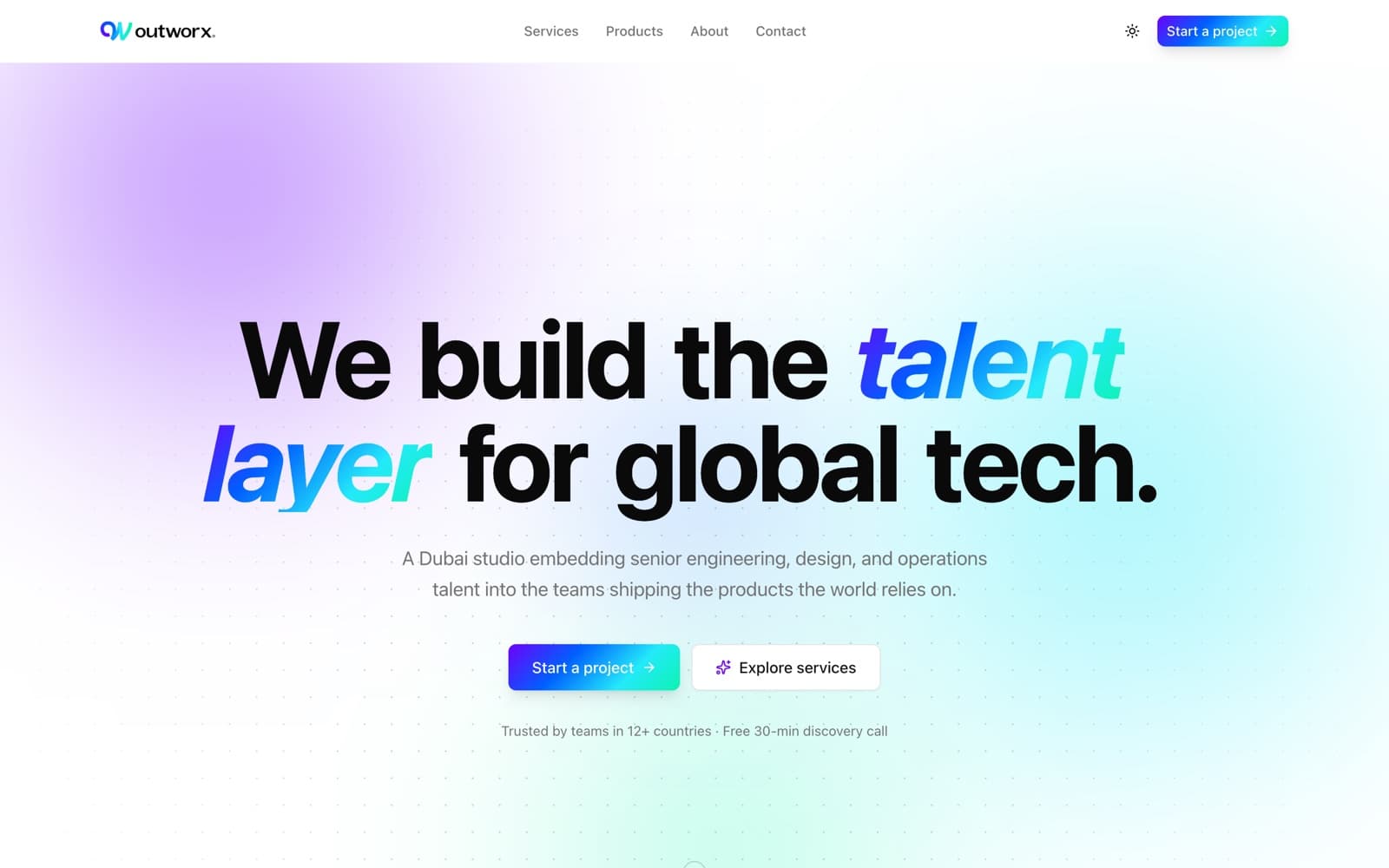
A licensed UAE software business building developer tools and AI-native platforms, alongside client engineering.
- I design, build, operate and bill the whole portfolio: architecture, backend, front end, infrastructure, subscriptions and support.
- The products share one multi-tenant foundation — authentication, organisations and roles, subscription billing, usage limits, custom domains and webhook delivery — which is why one person can run this many of them.
- Remote MCP servers secured with OAuth 2.1 and PKCE across the portfolio, exposing organisation-scoped tools that let Claude and Cursor query real application data.
- Next.js
- TypeScript
- Node.js
- PostgreSQL
- Vercel
- Stripe
- MCP
- Oct 2022 — Oct 2026Dubai, UAE
Greenbull Technology
Front-end lead, promoted from senior engineer
Joined as a senior mobile engineer and was promoted to front-end lead inside the first year, owning front-end architecture and delivery across the group's web and mobile products.
- Built three of the group's production apps single-handedly, front end and back end, and the entire front end of a fourth product — the case study covers what that required.
- Architected the shared front-end foundations reused across applications: component systems, state management, navigation, and release pipelines for iOS, Android and web.
- Production integrations across real-time data streaming over WebSockets and Socket.IO, in-app purchases on both stores, push notifications and media processing.
- Hardened releases with SSL pinning, secure storage and unit testing, and owned App Store and Google Play release cycles end to end.
- Set the front-end engineering standards, ran code review, and mentored engineers on architecture, tooling and delivery.
- React Native
- Expo
- TypeScript
- Next.js
- Socket.IO
- Apple IAP
- Google Play Billing
- Oct 2021 — Oct 2022Dubai, UAE
Emaar
Senior software engineer — U By Emaar
A year on U By Emaar, Dubai's flagship loyalty platform across Address Hotels & Resorts, Vida, Armani Hotel Dubai, Reel Cinemas and Dubai Aquarium.
- Built and shipped core member journeys — stay bookings, payments, offers, dining, receipt scanning and attractions — against Emaar's backend services and third-party partner systems.
- Owned the in-app experience for the annual flagship events, including New Year's Eve, where the feature ships against a date that cannot move.
- Improved codebase health and release stability through refactoring and defect work across the application, and contributed features to the Emaar One app.
- React Native
- TypeScript
- REST
- Enterprise integrations
U By Emaar · App Store — 4.8★, 12,473 ratingsU By Emaar · Google Play — 4.6★
- Apr 2021 — Aug 2021Ireland, remote
Codejam Café
Senior React Native developer
Production React Native features built to pixel-accurate designs.
- Led code review for the mobile team and enforced unit-testing standards across the codebase.
- React Native
- JavaScript
- Jest
- Sep 2020 — Mar 2021Saudi Arabia, remote
Shopz
Senior React Native developer
Mobile features for the company's commerce product, from technical approach through tested release.
- Chose the approach and libraries for new modules, and delivered releases on schedule against a remote brief.
- React Native
- JavaScript
- REST
- Apr 2019 — Sep 2021Cairo, Egypt
Entlaqa
Senior React Native developer
Owned mobile feature delivery and the front-end technical decisions — which technologies and patterns new work was built on.
- Led code review, mentored team members, and contributed to product and business planning alongside the engineering work.
- React Native
- JavaScript
- Firebase
- Jul 2018 — Apr 2019Cairo, Egypt
Designfy
React Native developer
Cross-platform mobile features built to specification as part of the product engineering team.
- Where the eight years start: shipping real features in a real codebase.
- React Native
- JavaScript